Bank Strike Deferred: 'Back to Normal' Is Missing Context
The three-day bank strike was deferred hours before it began. But the Sunday shift had already been worked, and the five-day week is still unresolved.
Verdict: missing context.
Primary source: UFBU circular of September 27, 2026, as reported by The Hindu →
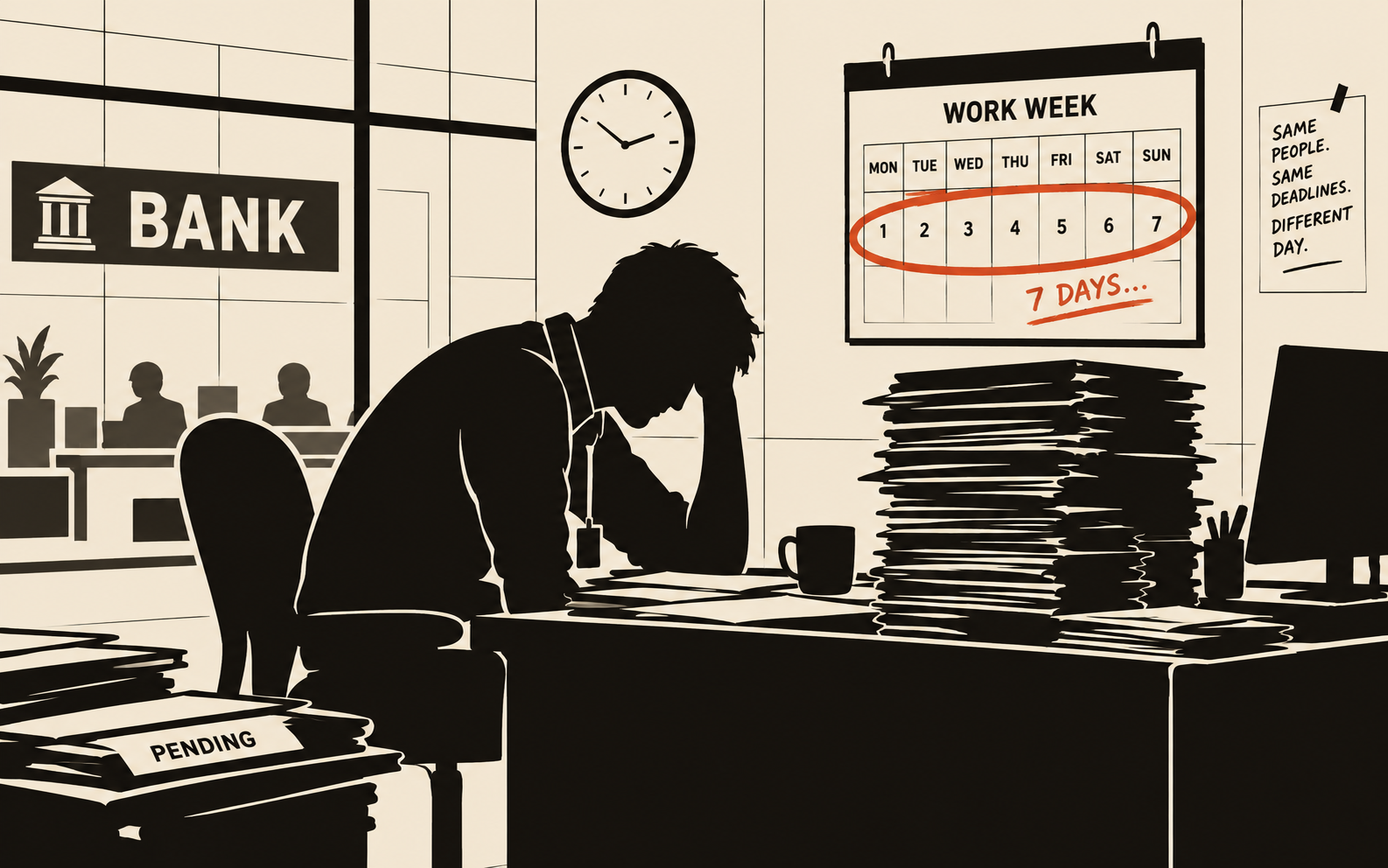
The deferral averted a banking shutdown, but it did not restore the weekly rest that staff had already spent. The dispute over the five-day week is unresolved.
Short answer: The three-day bank strike was deferred late on Sunday, September 27, after talks that began around 9:30 p.m., hours before it was due to start. For customers, the claim of a normal week is accurate. For bank staff, it skips the part that mattered. Public sector banks had already opened that Sunday on RBI directions, so the weekly holiday was worked before the deferral. The UFBU circular says workmen got double overtime and officers got one day’s wage. It does not promise a replacement day off. The next morning was a working day, and the five-day week was not approved. Two Union Bank employees died in separate road accidents that Sunday while commuting for the duty. “Back to normal” describes the branch queue, not the people who staffed it.
Correction (2026-11-15): This article consolidates the companion piece “The Human Cost of Mandatory Sunday Duty.” The earlier versions presented the seven-day run as the experience of bank staff generally, without spelling out that it applied to employees who worked the Sunday shift and the following working Saturday. They also described Neha Gupta as “compelled” to attend Sunday duty without attribution. That allegation comes from a bank employees’ organisation and has not been established. The earlier version said Gupta was travelling to work; she was returning home after the shift. It also ran the two deaths as part of the same deferral story without making clear that both crashes happened before the late-night announcement. The compensation terms and the status of the five-day week have been corrected and sourced.
1. The claim: no strike means no disruption
On Sunday night, the United Forum of Bank Unions (UFBU) deferred its three-day strike, which had been set for September 28 to 30. The decision came after a meeting with the Indian Banks’ Association (IBA). C. H. Venkatachalam, general secretary of the All India Bank Employees Association, told The Hindu: “All banks will function normally now. There will be no strike.”
That quote is the basis for the claim. If branches open on Monday, customers see no shutdown. The queue moves. The salary credit clears. The cheque is processed.
The claim is true for customers. It is incomplete for staff. A deferred strike does not undo the work that was already done to prepare for it. In this case, that work included a full Sunday shift.
2. What happened on Sunday, September 27
Public sector banks and regional rural banks opened on Sunday, September 27, on the RBI’s instructions, according to The Economic Times. The move was meant to clear transactions before the strike was due to begin on Monday.
Livemint reported that bank employees across the country reported for work that day, even though it is normally a weekly holiday. The same report describes the sudden change in plan after the late-night talks, and the meme wave that followed.
The timing matters. The IBA and UFBU met at around 9:30 p.m. on Sunday, according to The Hindu and Livemint. The UFBU circular went out late that night, according to The Hindu. The strike was deferred hours before it was to start.
By then, the Sunday shift was over for most staff. The deferral did not cancel it. It only changed what came next.
3. What staff got for working Sunday
The UFBU circular set out the compensation. Upstox, which reviewed the circular, reported that workmen employees would be paid overtime at double the rate under the bipartite settlement. Officers who attended office would receive one day’s wage.
That is pay, not rest. The sources reviewed for this article do not mention a compensatory holiday or a replacement weekly off. The circular addresses money, not time.
This is the first gap in the claim. “Back to normal” suggests the week reset. It did not. The weekly holiday had already been spent, and the next morning was a working day because the strike was off.
4. The seven-day question
The original version of this article said bankers faced a seven-day work week. That needs narrowing.
For a public sector bank employee who worked Sunday, September 27, and then the following working Saturday, the run was seven consecutive days. October 3, 2026 was the first Saturday of the month. Under the RBI’s 2015 rule, banks close on the second and fourth Saturdays and work full days on the other Saturdays, as Business Standard reported at the time. Unless a local holiday intervened, October 3 was a working Saturday.
The deferral is part of that arithmetic. If the strike had gone ahead, Monday to Wednesday would have been strike days, not working days. The deferral turned them back into working days. The Sunday shift plus the resumed week plus the working Saturday produced the seven-day run.
But the claim does not apply to every bank employee. Staff who did not work Sunday were not affected. Private banks and branches with different Saturday schedules may differ. The accurate statement is narrower than “all bankers face seven days.” The accurate statement is that staff who worked the Sunday shift lost their weekly rest, and some of them worked seven days straight.
5. The two deaths on that Sunday
The Sunday duty also produced the human cost that the claim leaves out. Two Union Bank of India employees died in separate road accidents that day.
Neha Rajivkumar Gupta, 36, was a Scale-II officer at the bank’s Regional Office in Vashi, Navi Mumbai. She was returning home after Sunday duty when a speeding taxi hit her autorickshaw near the Sarsole signal on Palm Beach Road in Nerul, according to Newsband and Lokmat Times. She died during treatment. Five other people were injured. The taxi driver, Mobin Asif Shaikh, 35, was arrested and booked under sections 106(1), 125(b) and 281 of the Bharatiya Nyaya Sanhita and provisions of the Motor Vehicles Act, Lokmat Times reported, citing PTI.
Newsband reported that Gupta had told officials she could not attend because no one was home to look after her children, and was subsequently asked to report. A bank employees’ organisation demanded an impartial inquiry, alleging that she was compelled to attend Sunday duty. That allegation has not been established in the sources reviewed here. Newsband attributes it to the organisation, and the police case it describes is against the taxi driver, not the bank.
Shri Venkata Prasad, branch manager of Union Bank’s Ranipet EAB branch in the Kancheepuram region, died in a road accident while travelling to his branch on Sunday morning, according to The Banking News.
Both crashes happened on September 27, before the late-night deferral. The deferral did not cause them. The Sunday duty is the common thread, and the “back to normal” framing erases it.
6. What the deferral actually settled
The strike was deferred, not withdrawn. Upstox reported that both the September 28 to 30 strike and the proposed indefinite strike from October 26 were deferred. The unions said they would monitor the implementation of the IBA’s commitments and review their action based on progress.
The five-day week was not approved. The Hindu, BusinessLine and The Economic Times all report that a high-level committee of the IBA and UFBU will examine the demand to declare the remaining Saturdays holidays. The Economic Times states plainly that the decision does not mean the demand has been accepted.
The other commitments are narrower. BusinessLine reported that discussions on modifications to the PLI scheme for Scale IV and above officers can begin, with a proposal to the government. Residual issues listed in the minutes of March 8, 2024 will be taken up for “expeditious resolution.”
So the deferral bought time, not a settlement. The next flashpoint was already on the calendar: the October 26 indefinite strike, which was also deferred rather than called off.
7. The verdict: missing context
The claim is not false. Banks did function normally on Monday. Customers did not face a three-day shutdown. The deferral was real.
The claim is missing the context that makes it honest. The Sunday shift was worked before the deferral. The compensation was overtime or a day’s wage, not a replacement holiday. The weekly rest was gone. Some staff worked seven consecutive days. Two employees died while commuting for the Sunday duty. The five-day week remains unresolved.
“Back to normal” is accurate for the queue at the branch. It is not accurate for the people who staffed it.
That pattern is not unique to banking. It shows up wherever a crisis is averted by asking workers to absorb the cost first. The same question applies to pay commission arrears and to banking failures that put customer data at risk: who pays for the contingency, and who is told it was normal.
Related coverage
Two other pieces on this site follow the money and the schedule behind this dispute. The unpaid arrears that make the seventh pay commission the reference point for every bank union demand are in the DA hike and the eighth pay commission. What a first paycheck means when it is the reason someone walks away is in the ex-Cognizant HR who quit for Goa.
Sources to check yourself
- The Hindu BusinessLine, September 27: the high-level committee, the remaining Saturdays and the March 8, 2024 residual issues.
- The Hindu, September 27: the 9:30 p.m. meeting and C. H. Venkatachalam’s quote.
- The Hindu, September 28: the UFBU circular and the four strike demands.
- The Economic Times: the Sunday opening on RBI instructions and the status of the five-day week.
- Upstox: the double overtime for workmen, one day’s wage for officers, and the deferred October 26 strike.
- Livemint: the Sunday shift and the late-night deferral.
- Newsband: Gupta’s age, route, time of death and the account of her request to be excused.
- Lokmat Times: the five injured, the arrest and the charges.
- The Banking News: Venkata Prasad’s death and the two-death toll.
- Business Standard, 2015: the second and fourth Saturday holiday rule.
Frequently asked questions
Q: Was the bank strike called off? A: It was deferred, not withdrawn. Upstox reported that both the September 28 to 30 strike and the October 26 indefinite strike were deferred. The unions said they would monitor the IBA’s commitments.
Q: Did employees get a compensatory holiday for working Sunday? A: The UFBU circular, as reported by Upstox, provides double overtime for workmen and one day’s wage for officers. The sources do not mention a replacement holiday.
Q: Is the five-day work week approved? A: No. A high-level committee of the IBA and UFBU will examine declaring the remaining Saturdays holidays. The Economic Times says the decision does not mean the demand was accepted.
Q: Did the deferral cause the two deaths? A: No. Both crashes happened on September 27, before the late-night deferral. The two employees were commuting for Sunday duty. The deferral did not cause the crashes, and it did not undo the duty.
Reader discussion
Conversation for this story opens with memberships. Until then: found an error? Report it — we correct visibly.