Loch Ness Monster Sightings Hit 15 in 2026, Up From Six Last Year. Is the Monster Real?
Reported sightings of the Loch Ness Monster have surged to 15 confirmed entries in 2026, up from six in 2025. Here is every dated sighting and what the evidence actually shows.
Verdict: true, with context.
Primary source: Official Loch Ness Monster Sightings Register →
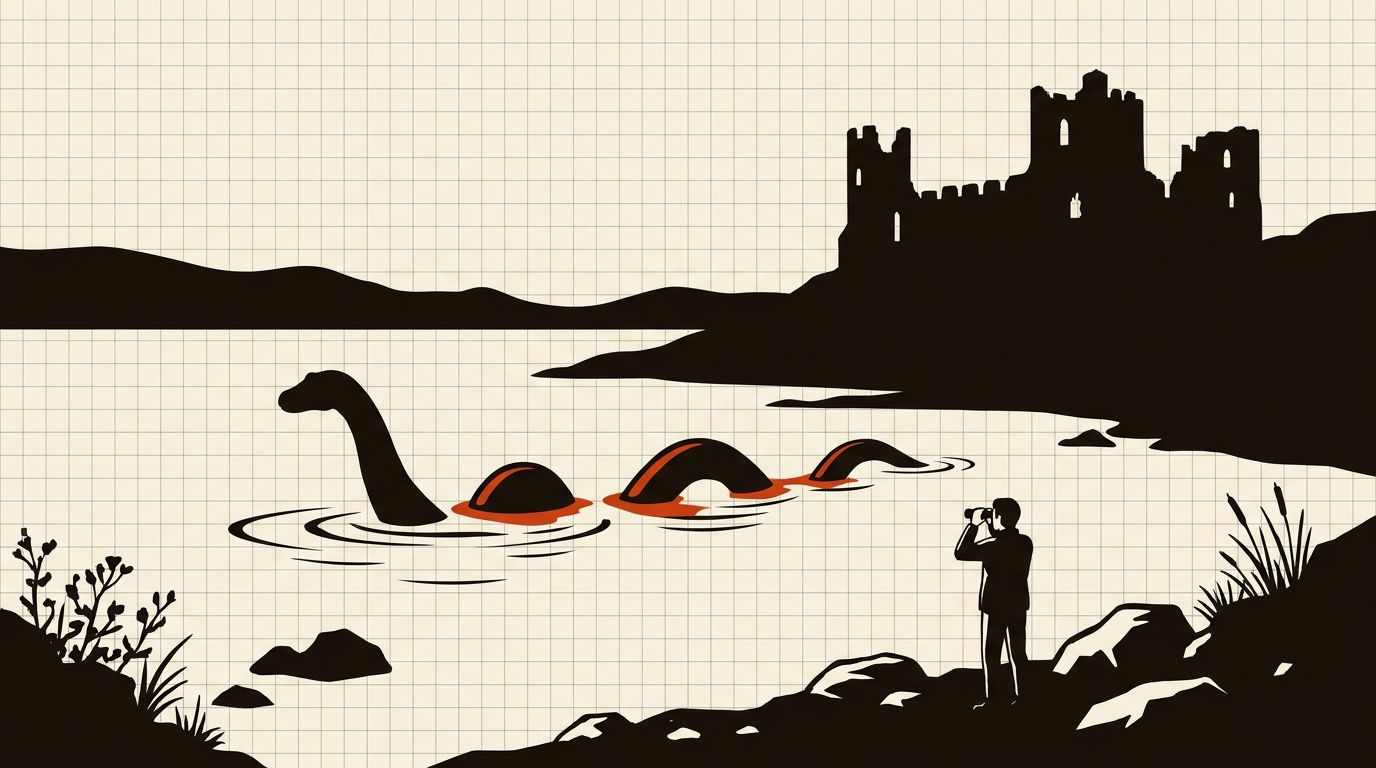
The sighting numbers are real and independently verifiable. What those sightings actually depict is a separate scientific question that the register itself does not answer.
Short answer: The numbers are real. Reported sightings of the Loch Ness Monster have reached 15 confirmed entries on the Official Loch Ness Monster Sightings Register in 2026, compared to six in all of 2025. The sightings come from visitors spanning multiple countries, include photographs, video, and live webcam captures, and range from brief surface disturbances to detailed descriptions of a multi-humped creature. Whether any of these observations represent an unknown animal rather than known wildlife, wave patterns, or debris is a question the register does not attempt to answer.
1. What the sightings register shows
The Official Loch Ness Monster Sightings Register is maintained independently and has tracked reported encounters since the early 20th century. It logs date, witness name or identifier, location on the loch, and a description of what was observed. As of autumn 2026, the register lists 15 entries for the year, a 150 percent increase over the six entries recorded in 2025.
The register does not evaluate whether a sighting represents an unknown creature. It records what people report seeing. That distinction matters, because the jump from 6 to 15 reflects more reports, not more proof.
2. Every dated sighting in 2026
| Date | Witness | What was reported | Method |
|---|---|---|---|
| 1 March | American visitor | Greenish-grey body, 5 to 10 feet long, emerged near the Caledonian Canal for about five seconds | In-person observation |
| 6 March | Webcam viewer | An object broke the surface four times, moving against the current near the Clansman Hotel | Live webcam feed |
| 23 April | Two tourists from Ontario, Canada | A large shape crested the water, leaving an S-shaped wake | In-person observation |
| 25 April | Cruise boat passenger | A water disturbance was photographed from a boat | Photograph |
| 21 July | Oscar Gray, Australia | Dark-green, flat-topped head and two humps near Urquhart Castle at around 3:30 PM | In-person observation |
| 23 July | Crystal (age 9) | Photographed a creature’s head from a cruise boat at 11:30 AM | Photograph |
| 5 August | Norbert, Malta | Described a 23-foot eel-like creature moving against the current | In-person observation |
| 6 August | Jocelyn, Barcelona | Recorded a 13-second video of a dark, mountain-like shape | Video (13 seconds) |
| 21 August | Felix, Germany | Reported a 6-metre (20-foot) long black object on the surface | In-person observation |
| September | Julie | Spotted three unusual objects via Google Earth satellite imagery | Google Earth |
Five additional entries bring the total to 15, though detailed descriptions for all entries were not publicly available at the time of publication.
The witnesses come from at least six countries: the United States, Canada, Australia, Malta, Spain, and Germany. That international spread is consistent with Loch Ness being one of Scotland’s most visited tourist destinations, drawing roughly 500,000 visitors per year.
3. What the data does and does not prove
The sighting count is verifiable. Anyone can check the Official Loch Ness Monster Sightings Register at lochnesssightings.com. Fox News and Fox 9 both reported the surge, citing the register directly. YouTube compilations and a Fox 26 Houston Facebook post have driven further social media engagement.
But a sighting count is not species identification. The register records subjective observations, not scientific data. Known explanations for Nessie sightings, proposed by researchers over decades, include:
- Boat wakes and standing waves: Loch Ness is 23 miles long and over 700 feet deep. Wind patterns and boat traffic generate surface disturbances that can appear organic from a distance.
- Large fish: The loch contains Atlantic salmon, brown trout, pike, and European eels, some of which can grow to considerable size.
- Floating debris: Waterlogged timber, vegetation mats, and decomposing organic material surface unpredictably.
- Otters and deer: Both swim in the loch, and their heads and backs above water can resemble a multi-humped profile.
- Optical illusions: At distance, the dark peaty water and surrounding hills create conditions where scale and shape are easily misjudged.
No scientific survey of Loch Ness has ever identified an unknown large animal. A major 2019 environmental DNA study led by Professor Neil Gemmell of the University of Otago sampled the loch’s waters and found DNA from many known species but nothing matching a large unknown reptile or plesiosaur. The study did note significant quantities of eel DNA, leaving open the possibility that unusually large eels could account for some sightings.
4. Why sighting numbers rise and fall
Sighting frequency correlates with factors that have nothing to do with an actual creature. Tourism numbers, webcam availability, media attention cycles, and even weather conditions (clear days produce more sightings than overcast ones) all affect how many reports the register receives in a given year.
The pattern is familiar from other viral phenomena. When a story about Nessie reaches mainstream media, more visitors look for the creature, more webcam watchers monitor feeds, and more people submit reports. That feedback loop inflates the count without requiring a real animal. Similar dynamics played out with the viral Juárez flying monster footage, where attention and engagement amplified a misidentified bird into a supposed living pterodactyl.
The register recorded 2 sightings in 2023, 6 in 2024, 6 in 2025, and now 15 in 2026. That trajectory aligns more closely with rising internet engagement and webcam infrastructure than with an animal population becoming more active.
Sources to check yourself
- Official Loch Ness Monster Sightings Register at lochnesssightings.com: Full list of dated entries with witness descriptions.
- Fox News: Reporting on the 2026 sighting surge and scientific investigations at the loch.
- Fox 9: Coverage confirming the jump from 6 to 15 sightings.
- YouTube compilations: Video roundup of 2026 sightings and individual sighting footage.
- Fox 26 Houston (Facebook): Social media post on the sighting uptick.
Frequently asked questions
Q: Is the Official Loch Ness Monster Sightings Register a scientific body? A: No. It is an independent record that logs what people report seeing. It does not investigate or verify whether sightings represent an unknown animal. Its value is as a consistent historical dataset, not as scientific evidence.
Q: Has any scientific study found evidence of a large unknown animal in Loch Ness? A: No. The most comprehensive study, a 2019 environmental DNA survey led by Professor Neil Gemmell of the University of Otago, found no DNA from any unknown large species. It did find significant eel DNA, suggesting large eels could explain some sightings.
Q: Why are there so many more sightings in 2026 than in previous years? A: The jump from 6 in 2025 to 15 in 2026 coincides with increased media coverage, more webcam watchers, and higher tourist traffic. Sighting counts correlate strongly with attention and access, not necessarily with an actual creature being present.
Q: Could Nessie be a surviving plesiosaur? A: Plesiosaurs went extinct approximately 66 million years ago. Loch Ness itself only formed roughly 10,000 years ago at the end of the last ice age. A cold-blooded marine reptile surviving in a freshwater loch that did not exist during its era is not supported by any evidence.
Reader discussion
Conversation for this story opens with memberships. Until then: found an error? Report it — we correct visibly.