Microsoft 365 and Outlook Down for 13 Hours: What Broke and What the Data Shows
A 13-hour global Microsoft 365 outage knocked out Outlook, Teams calendars, and Copilot, peaking at 138,058 Downdetector reports while disrupting OpenAI and Anthropic connectors.
Verdict: true, with context.
Primary source: Microsoft 365 Status incident disclosures, Downdetector telemetry, and OpenAI/Anthropic status notices →
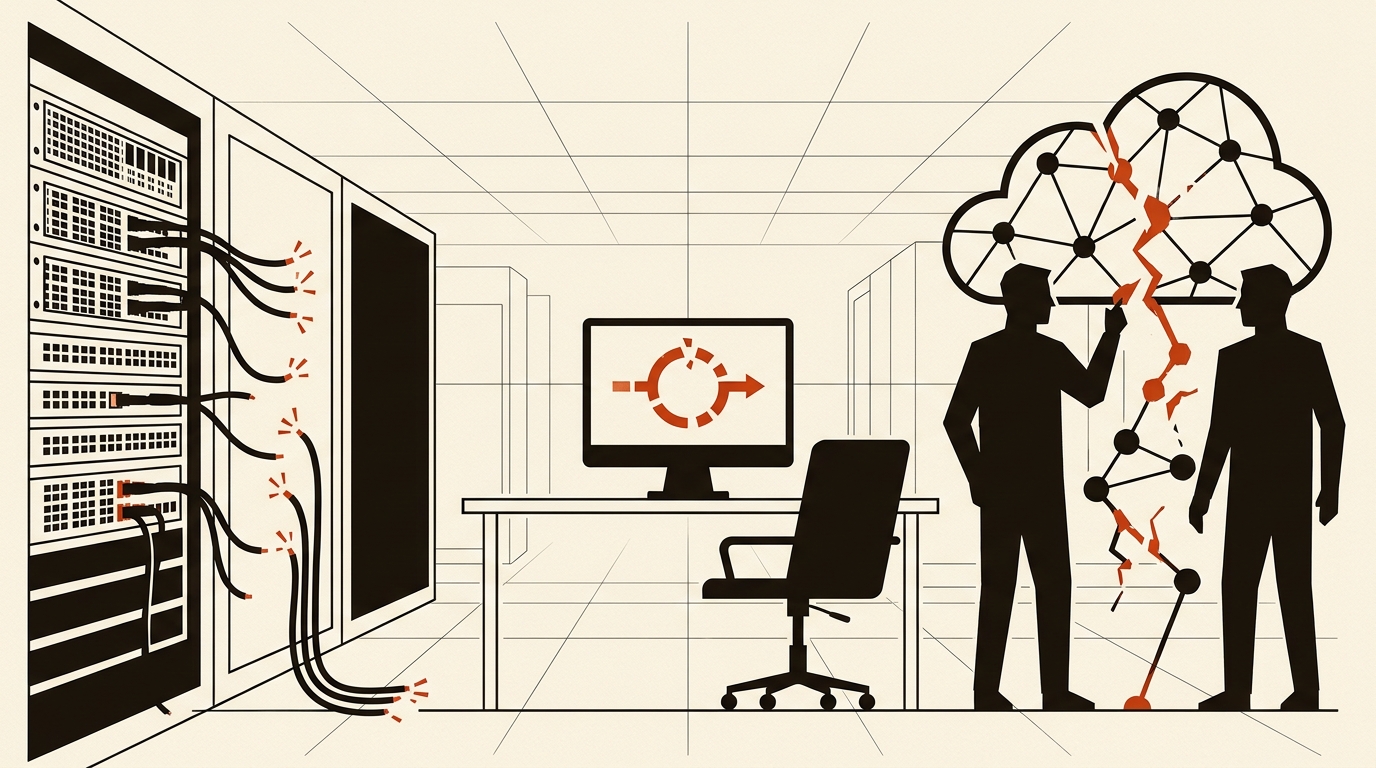
When a single authentication bottleneck knocks out Exchange Online, enterprise email, and connected frontier AI models across millions of workers, cloud concentration risk becomes impossible to ignore.
Short answer: It was not a cyberattack, nor was it caused by a sudden traffic surge. A global Microsoft 365 outage crippled Outlook, Exchange Online, Copilot, and Teams scheduling for over 13 hours on Friday, peaking at 138,058 user reports on Downdetector. Microsoft confirmed the root cause was an internal software bottleneck: a process responsible for establishing secure handshakes became overwhelmed, crashing server capacity and leaving fewer operational machines available to route traffic. The failure quickly rippled into third-party artificial intelligence platforms, breaking Microsoft 365 data connectors for both OpenAI and Anthropic.
1. What the incident telemetry reveals
The disruption began cascading across global time zones late Thursday night and stretched well through Friday morning. On incident monitoring platform Downdetector, complaints surged abruptly as corporate employees across Europe, North America, and Asia found mailboxes inaccessible and automated calendar syncs halted.
Incident metrics track the sharp rise and gradual recovery of the failure:
| Telemetry Milestone | Metric or Observation | Source / Verification |
|---|---|---|
| Peak incident reports | 138,058 simultaneous complaints at 1:30 AM | Downdetector tracker |
| Mid-recovery volume | 34,490 reports by 4:30 AM | Downdetector tracker |
| Duration of disruption | Over 13 hours across affected zones | Microsoft 365 Status updates |
| Official updates posted | More than 15 status bulletins on X | @MSFT365Status communications |
| Core architectural point | Exchange Online backend routing failure | Microsoft official incident log |
Microsoft issued its first formal progress statement at 3:30 AM on Friday, indicating that engineering teams were testing emergency configuration changes on a subset of host machines before rolling updates out more broadly alongside server restarts.
2. Why the servers choked: The actual root cause
Whenever a major productivity suite goes dark, workplace chat channels fill with speculation about state-sponsored cyberattacks or distributed denial of service strikes. Similar fears arose during recent large corporate security incidents and exposed bank servers, but Microsoft technical bulletins confirmed that this outage was entirely structural and self-inflicted.
Microsoft engineers identified three technical factors behind the collapse:
- Secure connection bottleneck: A background process tasked with establishing secure handshakes and cryptographic sessions on frontline servers became overloaded, causing affected nodes to stop processing new inbound requests.
- Fewer available servers, not more traffic: Microsoft explicitly clarified that total network traffic did not spike. Instead, as machines failed automated health checks and entered unserviceable states, the pool of available servers shrank, concentrating normal loads onto an ever-smaller number of surviving instances.
- Network configuration rollback: Engineers began reversing a recent network configuration change that coincided with the beginning of the outage to determine whether unexpected routing rules triggered the cascade.
Recovery was slowed by synchronization friction. While Microsoft attempted to force healthy network configurations onto frozen machines and scale up fresh virtual machines to absorb demand, several host clusters failed to synchronize properly, requiring manual intervention and phased traffic throttling.
3. Which Microsoft services went down and what survived
Because modern enterprise software shares integrated cloud infrastructure, a problem inside Exchange Online quickly cascaded through multiple daily tools:
- Exchange Online and Outlook: Users were blocked from accessing mailboxes through Outlook on the web, mobile applications, and desktop clients, while outgoing and incoming email queues faced severe delays.
- Microsoft Copilot: The company flagship AI assistant failed to load chat windows or return answers on desktop and web interfaces. Crucially, its ability to parse work data, including calendars, recent spreadsheets, and inbox histories, was completely severed.
- Microsoft Teams: Basic messaging and live video calls remained largely functional. However, any feature depending directly on Exchange Online, such as calendar views, meeting scheduling, and chat creation within organizations using Information Barriers, broke entirely.
- Administrative and security suites: The outage spread into Microsoft Defender, Microsoft Purview, Microsoft Graph, Microsoft Fabric, Power BI, SharePoint Online, Universal Print, and Windows 365 cloud desktops.
- Education tools: Schools and universities using Microsoft 365 Education experienced failures across digital Assignments, Reading Progress, and Speaker Progress trackers.
Only standalone workloads with zero runtime dependencies on Exchange Online identity authentication remained fully operational throughout the day.
4. The ripple effect on OpenAI, Anthropic, and corporate operations
The most significant takeaway for enterprise technology managers was how quickly an internal Microsoft disruption damaged external artificial intelligence platforms. Both OpenAI and Anthropic run connectors that link their large language models to corporate Microsoft 365 tenants, allowing workplace bots to summarize executive schedules and draft responses.
During the outage, both AI developers posted formal incident notices:
- OpenAI: Disclosed an active investigation into Microsoft connectors, warning customers that failing handshakes were blocking connections and causing workplace tools to malfunction.
- Anthropic: Confirmed that an upstream provider failure had impaired Claude enterprise connectors linked to Microsoft accounts.
Beyond software developers, the cloud freeze disrupted corporate disclosures. Electric truck maker Workhorse Group announced it was forced to postpone its third-quarter financial results from November 12 to November 16, citing operational roadblocks caused by the global Microsoft failure.
5. What this means for cloud and AI infrastructure bets
This 13-hour disruption arrived only weeks after Microsoft experienced a separate outage across its core Azure cloud platform, raising fresh questions about enterprise resiliency.
Major technology companies are currently spending record capital outlays on data centers and artificial intelligence computing, as analyzed in our 2026 tech layoffs report covering payroll reallocations toward silicon. At the same time, companies like Microsoft have trimmed thousands of corporate and operational roles, including the recent 60,000-person Voluntary Exit Offer program.
When deep workforce restructuring happens alongside aggressive infrastructure expansion, maintaining complex distributed network dependencies becomes higher risk. A single stuck handshake protocol brought down corporate communication and stalled frontier AI agents across multiple continents.
As enterprises connect more automated workflows to centralized cloud ecosystems, Friday outage proves that a failure in core authentication can instantly freeze everything from classroom grading to quarterly earnings.
Sources to check yourself
- India Today Technology: Reporting on the 13-hour global disruption, Downdetector report peaks, and official company statements.
- Downdetector Incident Telemetry: Real-time problem reports tracking the 138,058 complaint spike for Outlook and Microsoft 365.
- Microsoft 365 Status: Technical investigation disclosures detailing secure connection process failures and virtual machine scaling.
- OpenAI and Anthropic Status Portals: Partner incident logs confirming Microsoft 365 connector malfunctions.
Reader discussion
Conversation for this story opens with memberships. Until then: found an error? Report it — we correct visibly.