Fadnavis Defends Torrent Power Project: Why State Backs Bhimashankar Tree Felling
Maharashtra Chief Minister Devendra Fadnavis strongly defended the ₹13,500-crore Torrent Power pumped-storage hydro project near Bhimashankar, arguing the facility offsets coal emissions equal to 40 lakh cars while promising 90,000 replacement trees.
Verdict: true, with context.
Primary source: Official statements by Maharashtra Chief Minister Devendra Fadnavis, Navi Mumbai Press Briefing, October 26, 2026 →
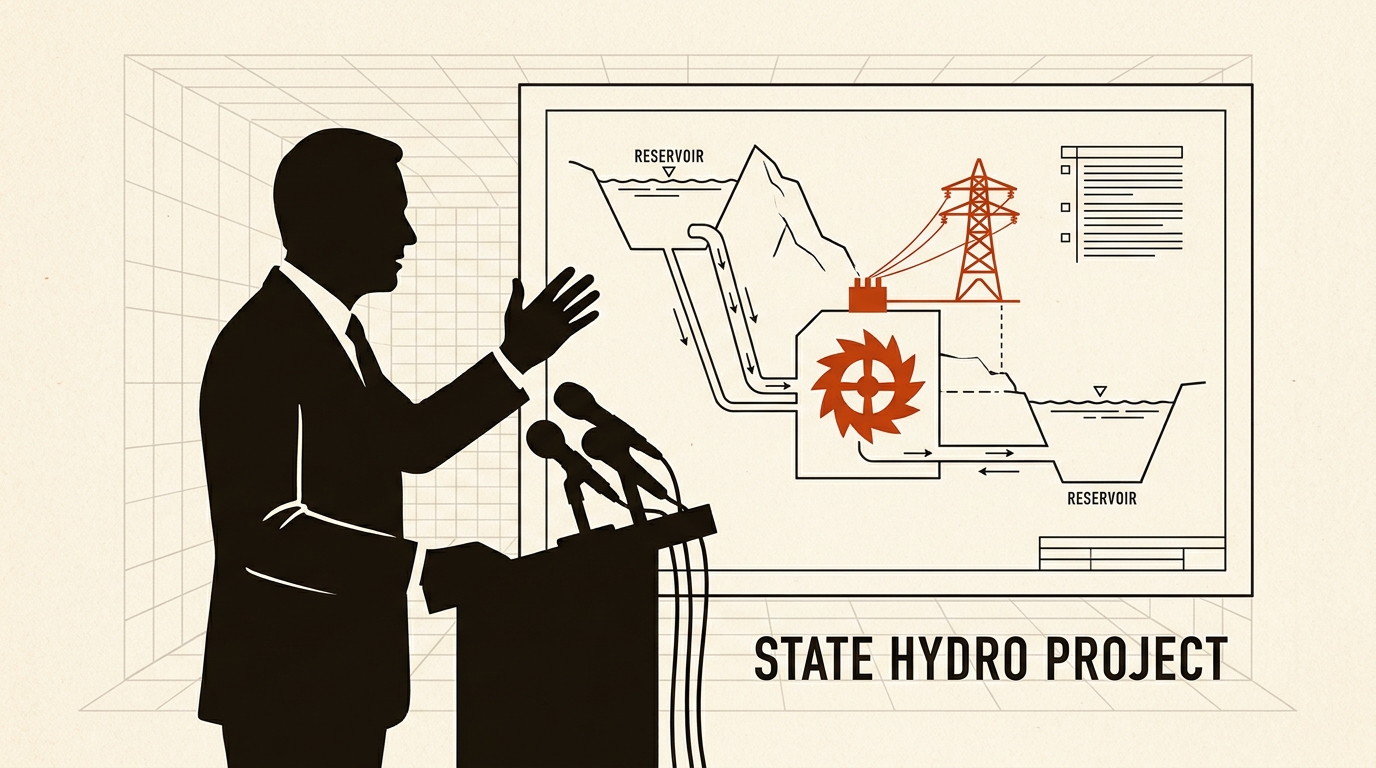
Balancing evening peak renewable power against fragile Western Ghats ecological protection sits at the center of Maharashtra energy transition strategy.
Short answer: Maharashtra Chief Minister Devendra Fadnavis delivered a detailed defense of Torrent Power’s 3,000-megawatt pumped-storage hydroelectric project during a press conference in Navi Mumbai on October 26, 2026. Responding to widespread opposition against tree felling along the Western Ghats ridge, Fadnavis maintained that the facility is vital for grid reliability when solar output vanishes after 5 PM. The Chief Minister asserted that generating the same capacity through coal-fired thermal plants would emit pollution equivalent to 40 lakh motor vehicles and require 28 crore trees to absorb. He noted that the project site sits 16 kilometers away from core Bhimashankar forest, with Torrent providing triple the diverted land back to the Forest Department alongside funding for 90,000 replacement trees.
1. What the state government argues
Public anger escalated in late October following ground reports of heavy excavators and tree marking across hundreds of hectares in the Karjat forest range. Environmental collectives, local Adivasi residents, and opposition parties mobilized against the clearance of over 32,000 trees for private developer Torrent Power, as documented in our ground report on the Western Ghats tree felling controversy in Karjat.
Speaking to reporters in Navi Mumbai, Chief Minister Devendra Fadnavis rejected characterizations of the project as ecological exploitation. He framed pumped-storage hydro stations as essential balancing infrastructure for clean power grids.
Fadnavis explained the structural challenge of the state’s energy matrix:
- The evening solar gap: Maharashtra has built massive solar generation arrays, but solar generation drops to zero after 5 PM.
- Peak hour stress: The subsequent four hours from dusk until late evening witness the highest power consumption of the day across industrial and household consumers.
- Thermal alternative cost: Relying on coal-fired power stations to supply 3,000 MW during peak hours causes severe carbon emissions and atmospheric smog.
The Chief Minister asserted that Maharashtra aims to become a national center for pumped-storage hydroelectric facilities. These installations draw excess solar power during daytime troughs to pump water to an elevated reservoir, then drop the water through hydro turbines to produce immediate dispatchable electricity when demand peaks.
2. What the environmental numbers reveal
Fadnavis presented official state metrics to support the government’s stance, comparing the environmental footprint of pumped storage against conventional coal power:
- Emissions offset: Operating a 3,000 MW coal thermal station releases emissions comparable to 40 lakh cars running on regional highways. Generating that volume through closed-loop hydro prevents that atmospheric load.
- Carbon absorption math: Fadnavis asserted that offsetting the emissions of an equivalent thermal plant would require planting 28 crore fully grown trees across its operating lifetime.
- Water conservation: Coal-fired thermal generation consumes 19 billion cubic feet of water each year for cooling systems. That volume can satisfy the annual drinking water requirements of 400,000 residents. The pumped-storage system recycles its reservoir volume continuously in a closed hydraulic loop.
- Land and replanting terms: Torrent Power has transferred almost three times the allocated project acreage to the Maharashtra Forest Department as compensatory land. The Forest Department will plant 30,000 trees on compensatory sites and 60,000 saplings around the project perimeter, funded by the company.
Addressing geography and local livelihoods, Fadnavis clarified that the active project boundaries lie 16 kilometers from the reserved Bhimashankar forest and 20 kilometers from the Bhimashankar Jyotirlinga temple shrine. He stated that the Union Ministry of Environment, Forest and Climate Change along with the state forest department conducted 18 months of statutory hearings before issuing clearances. He promised that any local resident whose traditional livelihood is affected will receive state assistance.
3. What’s missing / the ecological footnote
While the government’s mathematical defense highlights carbon offsets and grid balancing, local ecologists emphasize the difference between macro carbon calculations and localized geological fragility.
Compensatory saplings planted on distant plains cannot instantly replicate the deep root networks of mature Western Ghats canopy. The Sahyadri ridge features steep basalt escarpments and weathered red laterite soil. Stripping over 32,000 mature trees across steep slopes alters subterranean drainage and exposes downstream villages to severe landslide risks. In recent years, unmonitored hill blasting and slope cutting in neighboring districts have precipitated deadly mudslides, an issue closely studied in our reporting on regional water hydrology and Western Ghats environmental strain.
The coastal basin also relies on high-altitude forest catchment to regulate monsoon runoff and filter regional air, which previously served as a barrier against coastal pollution before unfiltered building dust broke Mumbai’s air shield.
Replacing old-growth rainforest trees with plantation saplings takes decades to deliver equivalent soil stabilization and microclimate regulation. While pumped-storage hydro offers cleaner power than coal, selecting high-biodiversity Western Ghats corridors for reservoir construction continues to draw sharp scrutiny from hydrologists and local forest communities.
Sources to check yourself
- Official transcript and video recordings of Chief Minister Devendra Fadnavis press briefing, Navi Mumbai
- Maharashtra Energy Department policy guidelines on pumped-storage hydroelectric projects
- Ministry of Environment, Forest and Climate Change statutory clearance documents for Raigad and Pune pumped storage
- Maharashtra Forest Department records on compensatory afforestation allocations and land transfers
Frequently asked questions
Q: Where is the Torrent Power pumped-storage project located relative to Bhimashankar? A: According to official government statements, the project boundary sits 16 kilometers from the Bhimashankar forest and 20 kilometers from the Bhimashankar temple complex.
Q: How many trees will be planted under the compensatory program? A: The state confirmed that the Forest Department will plant 90,000 trees at company expense, comprising 30,000 on compensatory land and 60,000 around the project site.
Q: Why does the government favor pumped storage over thermal power? A: The administration states that pumped storage provides clean dispatchable electricity during peak evening hours, avoiding thermal emissions equal to 40 lakh vehicles and saving 19 billion cubic feet of water annually.
Reader discussion
Conversation for this story opens with memberships. Until then: found an error? Report it — we correct visibly.