Diwali 2026 Pollution Alert: Why Delhi's AQI is Crossing 400 and What Data Shows
Delhi-NCR enters the severe air quality zone during Diwali 2026 as firecrackers, stubble burning, and winter weather trigger a toxic pollution spike.
Verdict: misleading.
Primary source: Central Pollution Control Board (CPCB) Sameer AQI Bulletins and SAFAR-India Winter Air Quality Forecasts →
Understanding the exact scientific breakdown between seasonal meteorology, farm stubble smoke, and episodic firecracker bursts determines whether emergency interventions like GRAP Stage IV can protect public respiratory health.
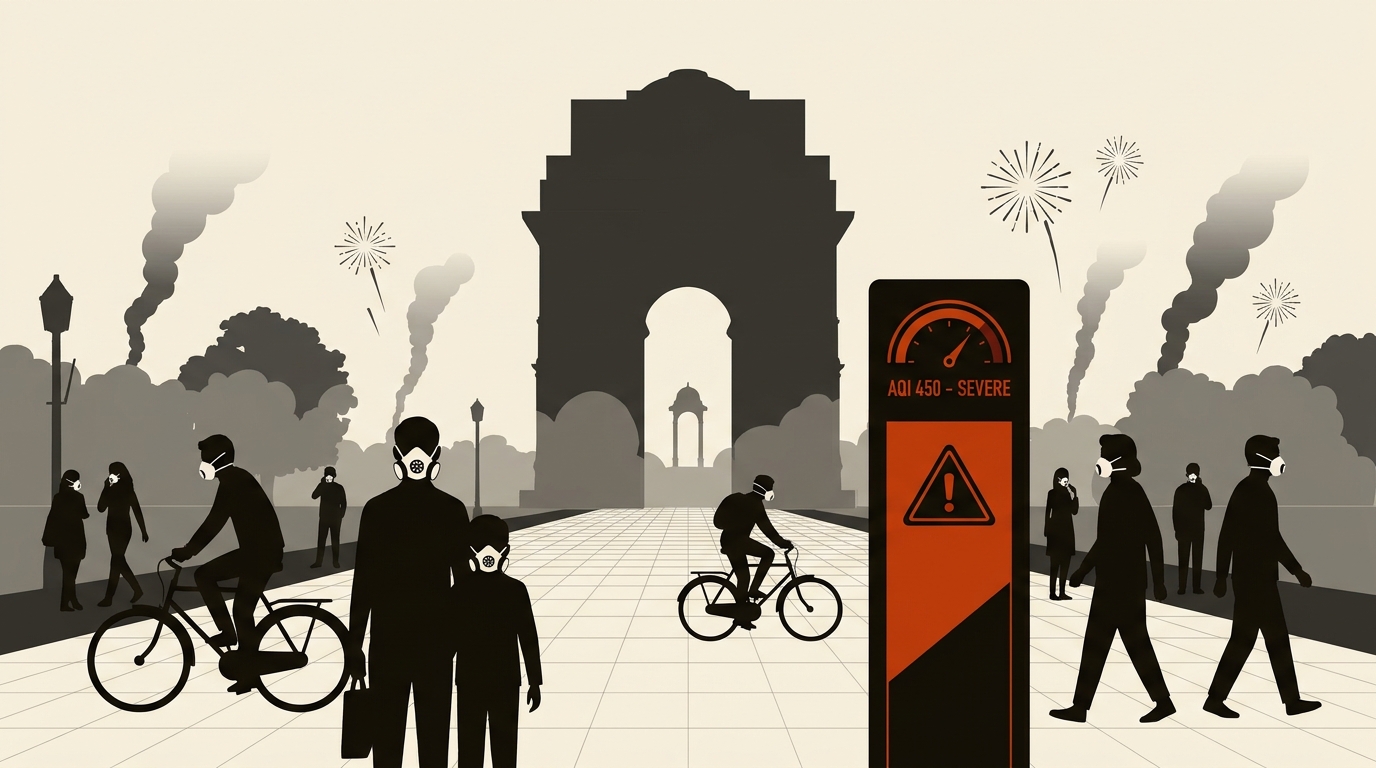
Short answer: The air over Delhi-NCR has deteriorated into the hazardous severe category, with the Air Quality Index surpassing 400 and regional hotspots crossing 450. However, blaming festive firecrackers alone is scientifically inaccurate. Scientific tracking from air quality agencies reveals that Delhi’s annual November crisis is caused by a toxic confluence of three simultaneous factors: peak farm stubble burning contributing 15 to 19 percent of microscopic PM2.5 soot, calm winter weather that traps ground-level emissions, and an episodic midnight burst of firecracker smoke. Together, these elements turn the national capital into an enclosed atmospheric gas chamber.
1. What the data forecasts for Delhi-NCR
As millions of families prepare for the festive weekend, air quality monitoring networks across the National Capital Region are flashing red warnings.
Official forecasts issued by the System of Air Quality and Weather Forecasting and Research (SAFAR) and the Central Pollution Control Board (CPCB) confirm a grim trajectory:
- Sustained severe conditions: The Air Quality Index (AQI) across Delhi-NCR is projected to remain firmly in the severe bracket (AQI 401 to 500) from November 6 through November 8.
- Extreme hotspot readings: Industrial and high-density monitoring stations, including Anand Vihar, Jahangirpuri, Wazirpur, and Bawana, are forecast to breach AQI 450, entering emergency hazardous territory.
- Midnight firecracker peak: While baseline pollution is already elevated, celebratory firecracker emissions will cause a sharp secondary spike starting around midnight on November 8 and lasting through the early dawn hours of November 9.
- Slow dissipation: Because surface winds are expected to drop below five kilometers per hour, the resulting sulfur dioxide, barium, and carbon particulates will linger over neighborhoods for days rather than blowing away.
When particulate matter reaches these levels, healthy individuals experience throat irritation and shortness of breath, while children, the elderly, and asthma sufferers face immediate medical peril.
Civic authorities frequently struggle to manage seasonal environmental hazards, a challenge seen during urban dust mitigation and construction air quality comparisons.
2. The toxic convergence: Stubble smoke and winter weather
To understand why northern India suffers this crisis every November, one must look at atmospheric physics rather than calendar festivities alone.
Delhi does not exist in an environmental vacuum. The current emergency is driven by a precise sequence of natural and human-made triggers:
- The stubble burning contribution: Harvesting schedules in Punjab and Haryana require farmers to clear paddy fields rapidly before planting winter wheat. Satellite fire-detection sensors show daily crop residue blazes peaking this week. Transport-level northwesterly winds carry this smoke directly into the Indo-Gangetic Plains, where agricultural residue accounts for 15 to 19 percent of all PM2.5 pollution in Delhi.
- The winter temperature inversion: During warm summer months, hot ground air rises naturally, carrying vehicle exhaust high into the upper atmosphere where strong winds disperse it. In November, falling nighttime temperatures create a phenomenon known as temperature inversion. A layer of cold, heavy air gets trapped beneath a ceiling of warmer air aloft. This warm layer acts like a giant physical lid, trapping all smoke, dust, and toxic fumes within a few hundred feet of the city streets.
- Urban baseline emissions: Even without stubble or firecrackers, Delhi’s baseline emissions are exceptionally high. Over fourteen million registered motor vehicles, brick kilns, unpaved road dust, and industrial zones ensure that air quality rarely drops below the poor category (AQI 200+) during winter months.
When midnight firecracker explosions release concentrated metal salts and sulfur into this already trapped air dome, the system reaches complete saturation.
Urban infrastructure strain often exposes deeper regulatory bottlenecks, echoing systemic issues highlighted during municipal resource management and civic service stress.
3. The national impact: Beyond Delhi’s borders
While television news channels focus almost exclusively on Delhi, official pollution records show that the Diwali air quality crisis extends across the entire northern and central heartland of India.
Research by atmospheric scientists tracks a consistent nationwide pattern during festival week:
- 29% to 60% PM2.5 surge: National monitoring stations record an average increase of 29 to 60 percent in PM2.5 concentrations during Diwali compared to pre-festival baselines across urban India.
- Tier-2 city deterioration: Cities situated across the Indo-Gangetic basin, including Lucknow, Patna, Kanpur, Meerut, and Faridabad, frequently record pollution readings comparable to or worse than central Delhi.
- Topography and wind differences: Coastal metropolises like Mumbai and Chennai generally escape the worst prolonged severe classifications because active sea breezes flush airborne particulates away within twelve to twenty-four hours. In contrast, landlocked northern cities remain shrouded in dense stagnant haze for an entire week.
Environmental monitoring networks continue to modernize, paralleling broader advances seen in early warning telemetry and environmental sensor limits.
4. Health emergencies and Stage IV restrictions
When the Air Quality Index crosses 400, breathing outdoor air carries the physiological impact of smoking twenty to twenty-five cigarettes a day.
Microscopic PM2.5 particles are small enough to bypass nasal filtration, penetrate deep into lung bronchioles, and enter the bloodstream, triggering systemic cardiovascular inflammation:
- Hospital emergency surges: Pulmonology wards across Delhi-NCR report a 35 to 50 percent surge in outpatient visits during the post-Diwali week, driven primarily by acute bronchitis, asthma attacks, and chronic obstructive pulmonary disease (COPD) exacerbations.
- Vulnerability in children: Pediatric physicians warn that children breathe at a faster rate than adults and possess smaller, developing airways. Exposure to concentrated toxic smog can cause permanent reductions in baseline lung capacity.
- Invoking GRAP Stage IV: In response to projections crossing 450, the Commission for Air Quality Management (CAQM) activates Stage IV of the Graded Response Action Plan. Emergency measures include barring non-essential diesel commercial trucks from entering Delhi, ordering a total halt on linear infrastructure construction, deploying mobile anti-smog water mist cannons, and advising both government and private offices to operate at 50 percent remote capacity.
Solving India’s recurring autumn air crisis requires moving beyond seasonal blame games. While regulating celebratory firecrackers provides immediate relief on festival night, long-term clean air depends on year-round industrial transitions, mechanized crop residue processing, and sustained public transport electrification across northern states.
Sources to check yourself
- Central Pollution Control Board Sameer Portal: Track real-time hourly AQI readings across hundreds of automated national monitoring stations.
- SAFAR-India Official Dashboard: Review scientific modeling on stubble fire contribution percentages and wind dispersion forecasts.
- Ministry of Environment, Forest and Climate Change: Read official statutory mandates for GRAP Stage IV emergency implementation.
- All India Institute of Medical Sciences Pulmonology Department: Review clinical guidance on protective N95 respirator usage and pediatric respiratory safety.
Frequently asked questions
Q: What is the projected AQI for Delhi-NCR during Diwali 2026? A: Delhi-NCR is forecast to remain in the severe category (AQI 401 to 500) from November 6 to 8, with localized hotspots expected to exceed AQI 450.
Q: How much does stubble burning contribute to Delhi’s air pollution? A: According to SAFAR dispersion modeling, crop residue burning in neighboring states accounts for approximately 15 to 19 percent of total PM2.5 particulate levels in Delhi during this peak period.
Q: When will firecracker pollution peak? A: Emissions from celebratory firecrackers are projected to spike sharply around midnight on November 8 and into the early morning hours of November 9, when wind speeds drop below 5 km/h.
Q: Do other Indian cities experience severe pollution during Diwali? A: Yes. National air quality data shows that PM2.5 levels rise by 29 to 60 percent across India during Diwali, with cities across the Indo-Gangetic Plains recording poor to severe air quality.
Q: What emergency restrictions are enforced under GRAP Stage IV? A: GRAP Stage IV bans non-essential diesel trucks from entering Delhi, halts non-essential construction, deploys water mist cannons, and encourages remote working to reduce vehicular emissions.
Reader discussion
Conversation for this story opens with memberships. Until then: found an error? Report it — we correct visibly.