32,000 Trees Slain in Karjat: How Western Ghats Forest Fell for Torrent Power
Heavy machinery began felling over 32,000 trees across 370 hectares in Karjat for a ₹13,500-crore Torrent Power project, sparking fierce backlash from local Adivasi communities and opposition leaders.
Verdict: true, with context.
Primary source: Maharashtra Forest Department Clearance Filings and Ministry of Environment Records →
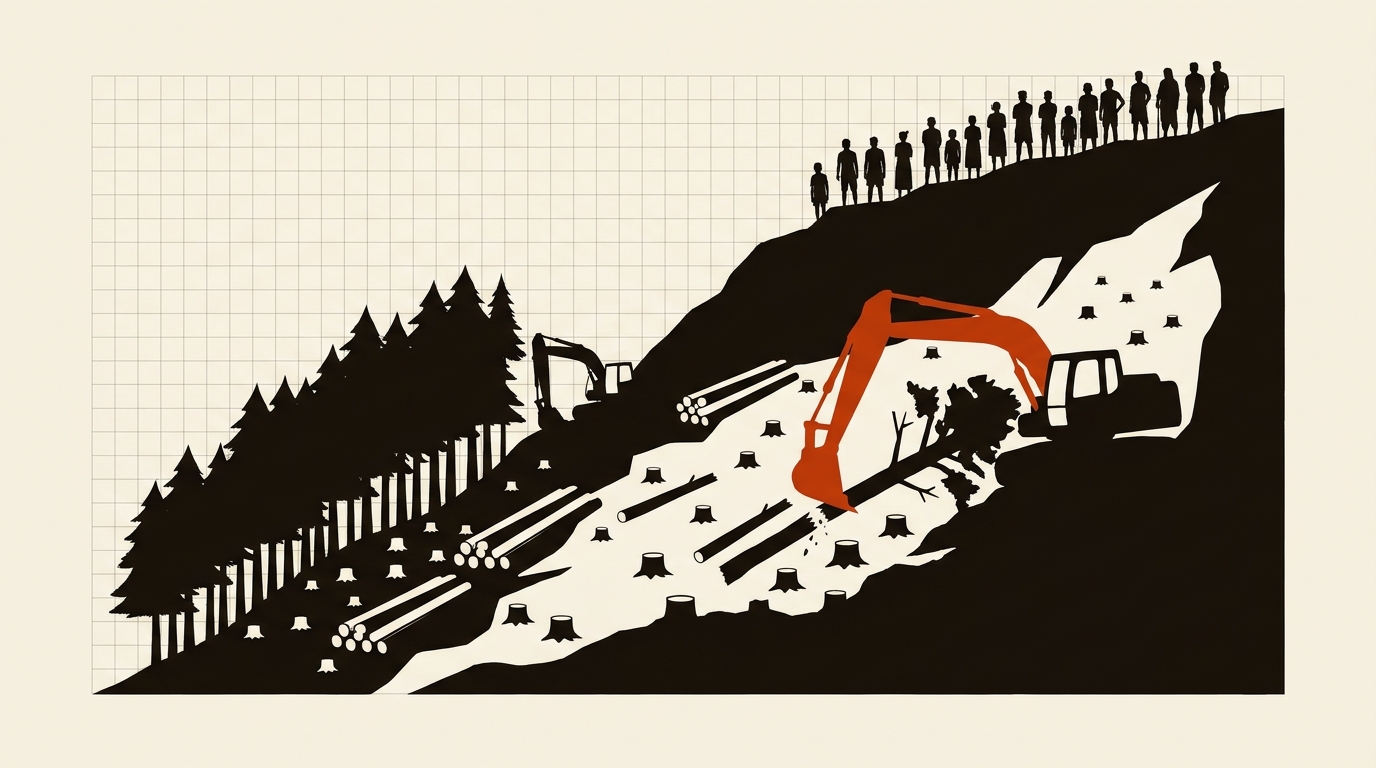
Clearing hundreds of hectares of dense Sahyadri forest threatens indigenous Adivasi settlements, fragile water tables, and increases severe landslide risks.
Short answer: The numbers and clearances are confirmed. Heavy contractors have started clearing more than 32,000 marked trees across 370 hectares of reserved forest land in Karjat. The land was allocated for a ₹13,500-crore pumped-storage hydro project developed by Gujarat-based Torrent Power, triggering intense public outrage over political funding links and ecological devastation.
1. What the ground felling reveals in Karjat
In the quiet hill hamlets of Saidongar, Kotwal Khalati, and Pali in Raigad district, the calm of the Western Ghats gave way to industrial saws and earthmovers. Forest boundary stones were driven into the soil as contractors began cutting broad swaths of green canopy.
Official state forest records confirm that over 32,000 trees are marked for felling across 370 hectares of steep ridge forest. Local environmental groups and grassroots forest workers estimate the total toll could cross 100,000 trees when counting understory growth, wild fruit orchards, and saplings.
The clearance clears land for a 3,000-megawatt pumped-storage energy facility awarded to Torrent Power. Pumped-storage stations act like giant water batteries. They pump water uphill to an upper reservoir during cheap off-peak hours, then release it through turbines when grid demand spikes. While billed as green transition infrastructure, building the twin reservoirs and connecting tunnels requires stripping mountain slopes down to bare rock.
2. The human and ecological cost along the Sahyadri ridge
The slopes of Karjat are not empty acreage. For centuries, indigenous Katkari and Thakar Adivasi families have lived along these forested ridgelines. The forest supplies seasonal medicinal herbs, wild tubers, mahua flowers, and firewood.
Perennial hill streams provide potable drinking water and irrigate modest paddy terraces downhill. When heavy earthmoving equipment cuts access roads into the mountain, local streams choke with loose silt and mountain aquifers dry up. Indigenous residents report that ancestral footpaths are blocked off by private security fences.
The affected stretch forms a critical ecological corridor linking northern Raigad to the Bhimashankar wildlife sanctuary belt. Dense canopy here shelters leopards, barking deer, Indian pangolins, wild boars, and dozens of rare Western Ghats bird species. Fragmenting this corridor pushes wildlife directly into populated valley settlements, multiplying human-animal conflict.
The environmental fallout also reaches urban centers. Coastal Mumbai and Pune rely on these high-altitude catchment forests to clean the regional atmosphere and regulate monsoon runoff, an issue we documented in our report on how unbridled development broke Mumbai’s air shield.
3. Electoral bonds, corporate ties, and the political firestorm
The project has triggered explosive political controversy over how government contracts and environmental clearances are granted. Torrent Group, headquartered in Ahmedabad, Gujarat, was identified in official Election Commission filings as one of the largest corporate buyers of electoral bonds, directing over ₹100 crore to the ruling Bharatiya Janata Party.
Opposition leaders pointed to this financial link as evidence of political cronyism. Shiv Sena (UBT) leader Aaditya Thackeray and NCP (SP) MLA Rohit Pawar traveled to Karjat to meet with protesting villagers. Thackeray publicly questioned how the Forest Department rushed clearances across sensitive ecological land to accommodate a corporate donor from Gujarat.
State officials rejected claims of wrongdoing. Minister of State for Energy Meghna Bordikar stated that the pumped-storage project underwent statutory environmental assessments. The government maintains that compensatory afforestation will be carried out elsewhere in the state, and that pumped storage is essential to support solar and wind grid stabilization.
For local villagers, promises of replacement saplings planted hundreds of miles away in another district offer no protection against local devastation.
4. Disaster risks and the shadow of Irshalwadi
The deepest fear among Karjat residents is geological instability. The Sahyadri mountains feature layered basalt formations with weathered red laterite topsoil. During intense monsoon cloudbursts, tree roots act as natural soil nails that bind steep hillsides together.
Stripping over 32,000 mature trees and blasting deep tunnels through mountain rock dramatically alters slope drainage. Local memories of recent mountain tragedies remain raw. In July 2023, a massive hillside collapse at Irshalwadi, just a short distance north in Raigad district, buried an entire tribal settlement alive, killing at least 86 people. A similar disaster flattened the village of Malin in neighboring Pune district in 2014.
Civil engineers and geologists have repeatedly cautioned that heavy slope excavation in high-rainfall Western Ghats zones invites slope failure. As analyzed in our review of Maharashtra water management and climatic stress, destabilizing mountain hydrology leaves downstream communities vulnerable to sudden flash floods and catastrophic mudslides.
Sources to check yourself
- Maharashtra State Forest Department: Project clearance notifications, diversion proposals, and compensatory afforestation filings.
- The Indian Express: Field reporting on Karjat tree-felling counts, local Adivasi demonstrations, and state cabinet approvals.
- The Hindu: Analysis of political controversy surrounding Western Ghats energy concessions and electoral bond disclosures.
Frequently asked questions
Q: How many trees are being cut in Karjat for the Torrent Power project?
A: Official forest department filings record over 32,000 mature trees scheduled for felling across 370 hectares of forest land, with local environmentalists estimating total plant loss over 100,000.
Q: What is the purpose of the Karjat pumped-storage project?
A: The ₹13,500-crore project is designed as a 3,000-MW pumped-storage facility, cycling water between two reservoirs to balance peak electrical grid demands.
Q: Why are local Adivasi communities and environmentalists protesting?
A: Protesters cite the loss of indigenous forest rights, destruction of vital wildlife corridors, contamination of local water streams, and heightened risk of fatal landslides.
Reader discussion
Conversation for this story opens with memberships. Until then: found an error? Report it — we correct visibly.