Fact Check: CJP Protests Over Election Commission SIR Exercise
Youth-led Cockroach Janta Party protests demand CEC resignation over alleged voter suppression in SIR exercise.
Primary source: Election Commission of India →
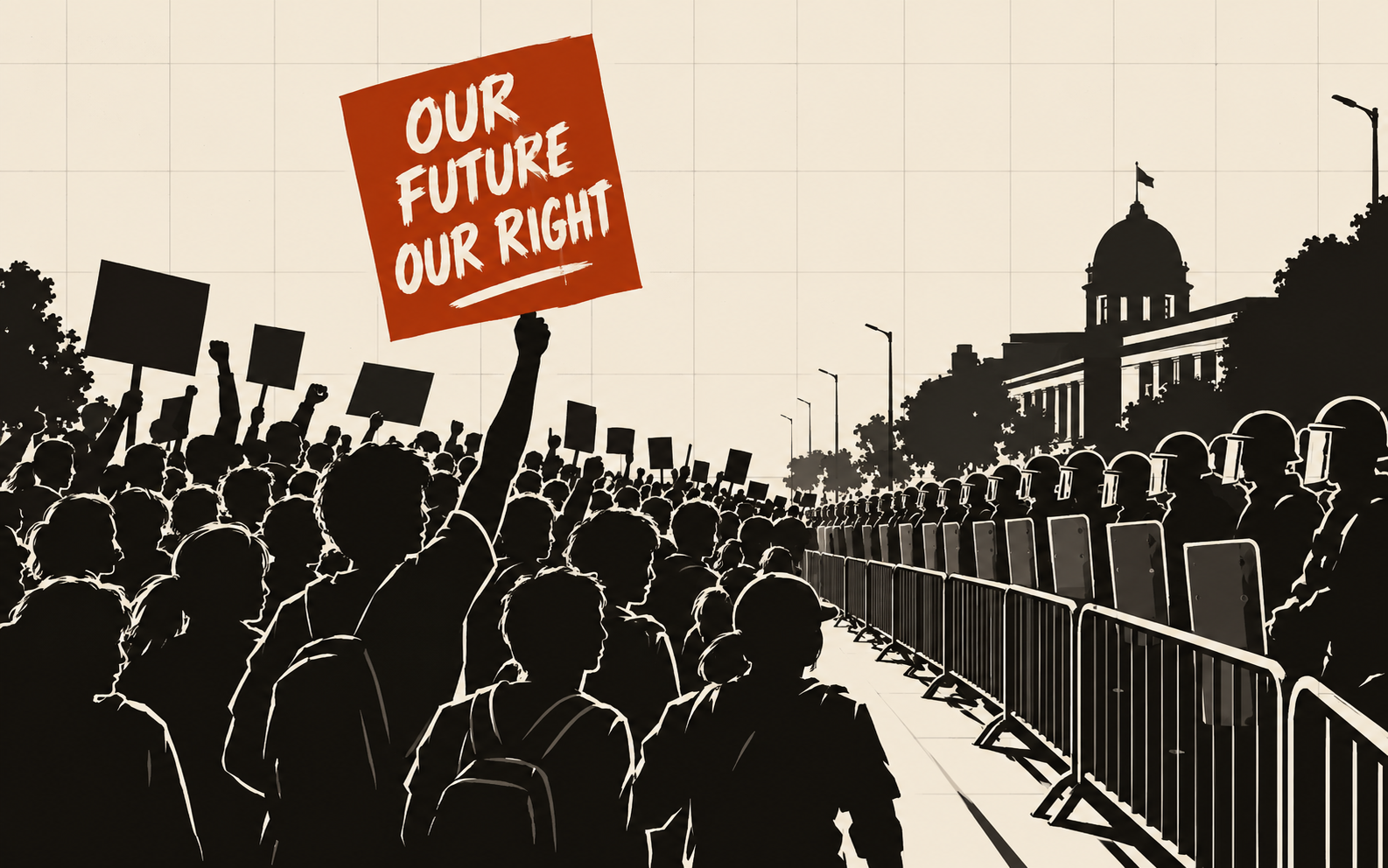
Massive youth protests are challenging the Election Commission over voter roll integrity.
Short answer: On October 2, 2026, the Cockroach Janta Party (CJP) led nationwide protests demanding the resignation of Chief Election Commissioner Gyanesh Kumar. The demonstrations centered on claims that the Election Commission’s Special Intensive Revision (SIR) exercise unfairly strips citizens of voting rights, leading to mass gatherings in Mumbai and severe police lockdowns in Delhi.
1. What the viral movement claims
The youth-led Cockroach Janta Party (CJP), which began as an online satirical movement similar to past student mobilizations like the LPU protests, has transformed into a political pressure group. The core demand is the immediate resignation of Chief Election Commissioner Gyanesh Kumar and a freeze on the Election Commission’s Special Intensive Revision (SIR) exercise. Protesters allege this exercise is a targeted voter suppression tactic that has stripped tens of millions of citizens of their voting rights. The Election Commission maintains that all decisions regarding the SIR were taken unanimously and legally.
2. Mumbai sees massive protests
Despite the Mumbai Police explicitly denying permission for a gathering at Shivaji Park, thousands of protesters poured into the iconic ground. Led by CJP founder Abhijeet Dipke, speeches contrasted the legacy of Mahatma Gandhi and Dr. B.R. Ambedkar with the current administration. Dipke warned of a mobilization if CEC Kumar does not step down. The protest saw veteran actors Shabana Azmi and Naseeruddin Shah, along with musician Vishal Dadlani, joining the ranks. Azmi passionately defended the right to vote and the constitutional right to protest.
The demonstration was marred by tragedy when a 75-year-old man from Kerala, Gopi Pillai, suffered a fatal cardiac arrest at Shivaji Park despite receiving immediate CPR. As the protests wound down, tensions flared. In the Dadar area, a scuffle broke out between returning CJP supporters and activists from an unnamed political party. Videos showed a tense confrontation where a human chain was formed, and police urgently intervened to disperse crowds after an activist allegedly grabbed a police officer by the collar.
The CJP also faced local pushback. A group calling itself Gen Next Mumbai held a counter-protest defending the Constitution against the CJP. Local Shivaji Park residents objected to the massive crowds, citing traffic paralysis, littered liquor bottles, and public nuisance. Advocate Siddhi Deolekar filed a formal police complaint against CJP leadership for violating silence zone norms. Politically, the ruling coalition dismissed the outrage. Maharashtra CM Devendra Fadnavis stated that the fake narrative against the Election Commission had already been busted.
3. Delhi lockdown and nationwide ripple effects
While Mumbai saw massive crowds gathering, the national capital was placed under a near-total lockdown, a scene reminiscent of recent Delhi women’s protests. Anticipating the protests at Jantar Mantar, Delhi Police turned the area into a fortress. The crackdown was absolute: internet services in the area were shut down, drones buzzed overhead for surveillance, and 11 major metro stations were closed. Over 700 people were detained, preventing them from reaching the protest site (The Hindu, 2026).
The outrage spread across the country. In Bengaluru, student groups and civil society organizations occupied Freedom Park, demanding the CEC’s ouster. In Jaipur, AAP workers engaged in a physical scuffle with local police at Shaheed Smarak while protesting the SIR exercise. In Latur, a group of students protested against CJP leader Abhijeet Dipke, hitting his poster with slippers. They accused him of abandoning the NEET paper leak issue.
Sources to check yourself
- The Hindu covers the Delhi crackdown and the 700 detentions of opposition leaders.
- The Times of India provides granular details of the Shivaji Park protest, Dipke’s speeches, and local resident complaints.
- Mid-Day includes video context of the post-protest physical altercation and police intervention in Dadar.
Frequently asked questions
Q: What is the CJP demanding? A: The Cockroach Janta Party is demanding the immediate resignation of Chief Election Commissioner Gyanesh Kumar and a freeze on the Election Commission’s Special Intensive Revision (SIR) exercise.
Q: Were there any casualties during the protests? A: A 75-year-old man named Gopi Pillai suffered a fatal cardiac arrest at the Shivaji Park protest in Mumbai despite receiving immediate CPR.
Reader discussion
Conversation for this story opens with memberships. Until then: found an error? Report it — we correct visibly.