Supreme Court CEC Gyanesh Kumar Hearing: 10 Days to Reply to ECI Affidavit on SIR
A three-judge Supreme Court bench gave petitioners 10 days to counter the Election Commission affidavit defending nationwide Special Intensive Revision of electoral rolls and CEC Gyanesh Kumar.
Verdict: false alarm.
Primary source: Record of Proceedings in Supreme Court of India, Bench of CJI Surya Kant, Justice Joymalya Bagchi, and Justice V Mohana →
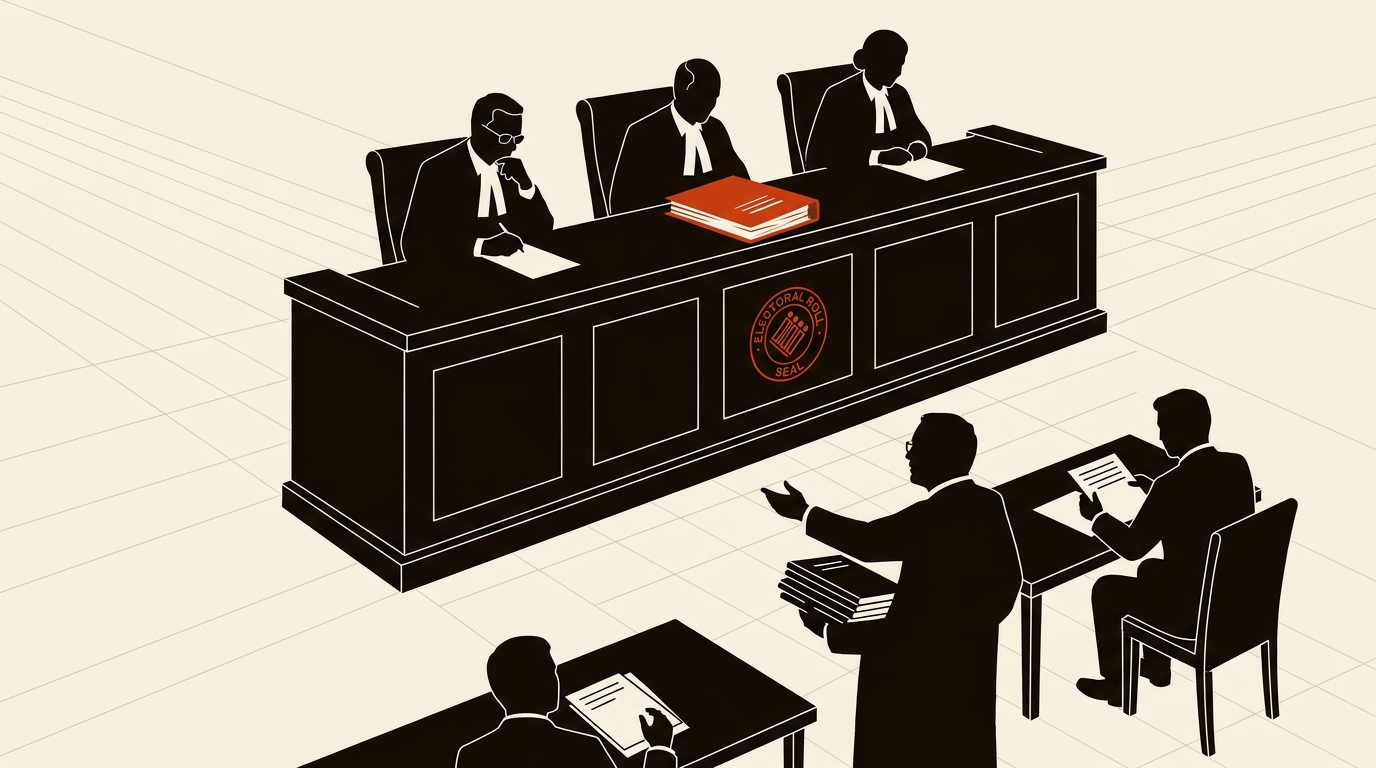
The petitions test whether the Election Commission decision-making followed statutory collective procedure and examine constitutional immunity granted to poll chiefs.
Short answer: The Supreme Court of India did not scrap the Special Intensive Revision (SIR) or order an investigation against Chief Election Commissioner Gyanesh Kumar. On Tuesday, October 27, 2026, a three-judge bench led by Chief Justice of India Surya Kant granted the petitioners ten days to submit a formal rejoinder to the Election Commission of India (ECI) counter-affidavit. The bench also issued notice on a fresh petition filed by Rajya Sabha Member of Parliament Dola Sen questioning statutory immunity for election commissioners, listing all connected matters for substantive hearing on November 17, 2026.
1. What the petitions against the CEC and SIR allege
A cluster of public interest litigations and writ petitions reached the top court challenging both the operational rollout of the nationwide Special Intensive Revision and the internal decision-making apparatus of the election body.
Social activist Rakesh Kumar Singh filed a primary petition arguing that Article 324(1) of the Constitution does not vest the superintendence, direction, and control of elections in an individual Chief Election Commissioner, but in a multi-member Commission. Singh pointed to reported administrative differences between CEC Gyanesh Kumar and fellow Election Commissioners Sukhbir Singh Sandhu and Vivek Joshi, urging the court to declare the entire SIR drive void from inception for lacking statutory and constitutional backing.
A second petition submitted by Delhi-based advocate Shailendra Mani Tripathi sought the constitution of an independent Special Investigation Team or a judicial inquiry commission headed by a retired Supreme Court judge to investigate administrative conduct within the commission. Similar pleas challenging voter list procedures have been filed by Lok Sabha Leader of Opposition Rahul Gandhi and senior opposition leaders.
During Tuesday proceedings, the court also took up a fresh writ petition moved by Trinamool Congress Rajya Sabha MP Dola Sen. Sen challenged:
- The constitutional validity of statutory clauses granting serving and former election commissioners lifelong immunity from civil and criminal proceedings for official actions.
- Whether the poll panel complied with collective consultation protocols prescribed under the Chief Election Commissioner and Other Election Commissioners (Appointment, Conditions of Service and Term of Office) Act, 2023.
- Alleged procedural modifications made to Form 6 during voter roll verification drives in Bihar without judicial sanction.
The three-judge bench issued formal notice on Sen plea, conjoining it with the main batch.
2. How the Election Commission defended the revision
In its counter-affidavit submitted before the bench, the Election Commission denied allegations of administrative unilateralism and defended the legality of the Special Intensive Revision.
The commission emphasized three core positions:
- Unanimous commission approval: The ECI affirmed that the affidavit itself and every substantive administrative order guiding the SIR were reviewed and approved unanimously by all three commission members, namely the Chief Election Commissioner and both Election Commissioners.
- Statutory basis of voter verification: The affidavit maintained that the Special Intensive Revision is fully justified under election laws to purify electoral rolls, remove duplicate entries, and register eligible citizens. The commission characterized petitioner accusations of arbitrary rule-making as misconceived.
- Form 6 clarification: The poll body addressed claims regarding voter registration modifications, describing allegations that Form 6 was illegally amended as misleading. The commission explained that the statutory Form 6 remained untouched, with revisions limited strictly to an annexed Additional Declaration used to introduce digital mapping of residential clusters.
The commission urged the court to dismiss the petitions, arguing that continuous updating of voter lists remains a foundational statutory responsibility rather than an unconstitutional measure.
3. Heated courtroom exchanges and the November 17 date
Senior counsel representing petitioners and the central government engaged in sharp arguments over the custody of internal administrative records before the bench of CJI Surya Kant, Justice Joymalya Bagchi, and Justice V Mohana.
Senior Advocate Menaka Guruswamy, appearing for petitioners, requested an interim direction to secure internal documentation:
“Preserve the files and the file notings. The response asserts a unanimous decision, but the file record does not reflect that consensus.”
Solicitor General Tushar Mehta, appearing for the Union government, strongly opposed the request:
“The request is unfair and based on conjecture.”
Senior Advocate Abhishek Manu Singhvi supported the preservation application, pressing the court to safeguard internal deliberations:
“This whole dispute turns upon decision-making, consultation, and whether consensus was reached. We are only asking that the original records and file notings be preserved.”
Chief Justice Surya Kant declined to enter into piecemeal findings at this preliminary juncture, stating:
“We are aware of everything; we will examine everything.”
The bench granted the petitioners ten days to file their comprehensive rejoinder to the ECI affidavit. All connected petitions will be taken up together for further examination on November 17, 2026.
Sources to check yourself
- Supreme Court of India Cause List and Case Status records for October 27, 2026
- Counter-affidavit filed by the Election Commission of India in Rakesh Kumar Singh v. ECI
- Text of the Chief Election Commissioner and Other Election Commissioners Act, 2023
- Indian Express and legal correspondent reports on the Supreme Court proceedings
Frequently asked questions
Q: Did the Supreme Court stay the Special Intensive Revision on October 27? A: No. The Supreme Court issued no stay on the SIR process and passed no adverse orders against CEC Gyanesh Kumar. The court gave petitioners 10 days to reply to the ECI affidavit.
Q: What is the fresh plea filed by MP Dola Sen? A: Rajya Sabha MP Dola Sen filed a writ petition challenging lifelong legal immunity for election commissioners under the 2023 Act and questioning voter registration Form 6 mapping in Bihar.
Q: When will the Supreme Court hear the matter next? A: The three-judge bench headed by Chief Justice of India Surya Kant scheduled the next hearing for November 17, 2026.
Reader discussion
Conversation for this story opens with memberships. Until then: found an error? Report it — we correct visibly.