Wall Street Loses $2.5 Trillion in Single Session: Did Midterms Pop the AI Bubble?
Wall Street suffered a historic $2.5 trillion single-day rout as tech giants crashed, sparking fierce debate over the real cause behind the selloff.
Verdict: false alarm.
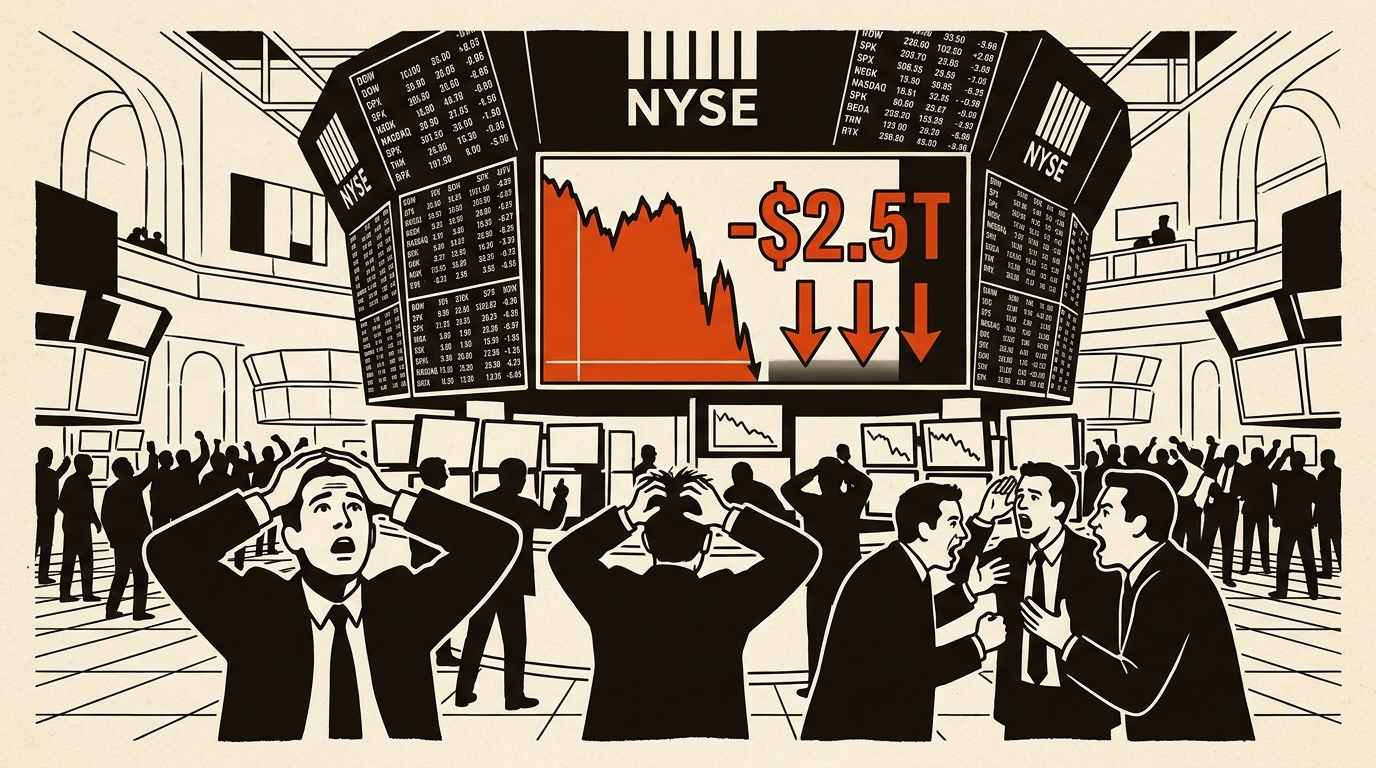
The sudden erasure of $2.5 trillion in market value exposes structural weaknesses in circular AI capital expenditures and tests whether political blame games can mask an overvalued technology sector.
Short answer: Thursday’s historic Wall Street crash was not simply caused by voters electing a Democratic Congress. While Donald Trump immediately blamed the midterm election results for wiping out 401(k) retirement savings, financial data reveals that the $2.5 trillion rout was primarily driven by a long-overdue reckoning in artificial intelligence stocks. Massive infrastructure bets had created an overstretched bubble that finally burst when investors questioned ballooning data center costs and weak software profits. The election results did not start the fire, but they poured fuel on an already fragile market.
1. Inside the $2.5 trillion market bloodbath
Trading desks across New York witnessed one of the most violent single-day selloffs in modern financial history. By the final closing bell on Thursday, approximately $2.5 trillion in shareholder wealth had vanished into thin air.
The numbers tell a staggering story of panic:
- Nasdaq enters correction: The technology-heavy Nasdaq Composite dropped 5.5 percent, recording its steepest single-day decline in eighteen months. The fall pushed the index down 10 percent from its recent peak, meeting the formal definition of a market correction.
- Dow and S&P 500 tumble: The Dow Jones Industrial Average dropped 1,833 points, falling 3.4 percent to end at 51,868. The broader S&P 500 posted its worst performance since April 2025.
- Universal market damage: This was not an isolated hit on a few tech companies. All eleven sectors of the S&P 500 ended deep in the red, with seven sectors shedding over 2 percent. Industrial giant Caterpillar dropped 6.4 percent, while JPMorgan Chase fell 4.2 percent.
- Fear index spikes: The CBOE Volatility Index, known across Wall Street as the VIX or fear gauge, exploded 61 percent higher. It marked the highest volatility level since the outbreak of hostilities in the Iran war.
- Global shockwaves: Asian exchanges absorbed immediate fallout on Friday morning. Japan’s Nikkei index dropped 6 percent, while South Korea’s Kospi plunged over 8 percent due to heavy exposure to memory chip suppliers.
Investors scrambled into safety, driving down benchmark ten-year Treasury yields as traders parked cash in government debt.
2. Why artificial intelligence stocks bore the brunt
While the broader market suffered, the absolute epicenter of the destruction was the artificial intelligence infrastructure trade. For over two years, investors treated chipmakers and server builders as invincible money machines. On Thursday, that narrative unraveled with astonishing speed.
Nvidia, which briefly held the crown as the world’s most valuable corporation, fell 9.3 percent. The plunge erased all of its year-to-date gains, flipping the stock into negative territory for 2026. Data storage and hardware providers were hit even harder: SanDisk crashed 22 percent, while Western Digital sank 17 percent.
The sudden collapse stems from three harsh financial realities that Wall Street could no longer ignore:
- Unsustainable capital expenditures: The world’s largest cloud providers have committed hundreds of billions of dollars to buying graphics processors and constructing gigawatt-scale data centers. However, paying corporate customers are simply not adopting enterprise AI software fast enough to generate matching cash flows.
- Power grid and infrastructure bottlenecks: Massive server clusters require unprecedented electricity supplies. Utility constraints and delayed turbine installations have forced companies to push back deployment timelines, leaving expensive chips sitting idle in warehouses.
- Circular revenues: A growing portion of AI revenue came from startups funded by tech giants using those very funds to rent cloud servers back from the same giants. Once venture capital tightened, the artificial revenue loop began to crack.
Corporate cost pressures have already forced major technology companies to rethink headcount, echoing wider patterns seen during widespread tech layoffs across top enterprise employers.
3. The spicy theory: Trump’s 401(k) blame versus Wall Street’s strike
Within hours of the market close, political combat took over the narrative. Donald Trump took to social media to pin the entire financial crash squarely on the Democratic Party’s sweeping midterm victories.
Trump posted a series of fiery messages attacking the election outcome:
“The Stock Market suffered one of the Worst Days in History based on the results of the Election. Such a sad thing to watch! It took so much work to get us to a level that no one has ever seen before, and then this. Your 401(k)s have, therefore, dropped. Remember, it wasn’t Republicans, it was Dumocrats.”
In a follow-up statement, Trump doubled down: “The Stock Market crashed today because the Dumocrats had a big Tuesday. So sad to see, you only have yourselves to blame!”
This sparked a spicy counter-theory that spread rapidly through institutional trading rooms.
The Capital Strike Theory: Did Wall Street intentionally pull the plug on equities as a political warning shot? Under two years of unified Republican rule, big tech and private equity enjoyed complete deregulation, minimal antitrust oversight, and relaxed environmental scrutiny. On Tuesday, Democrats flipped both the House of Representatives and the Senate.
Suddenly, corporate boardrooms faced the near certainty of aggressive congressional investigations, new taxes on corporate stock buybacks, and federal regulations targeting AI data center energy consumption. Proponents of the theory argue that major institutional funds dumped equities not just out of panic, but as a deliberate demonstration of leverage. By crashing the market immediately after the vote, finance titans sent a clear message to incoming Democratic committee chairs: leave corporate tax cuts and tech mergers alone, or risk wiping out everyday voters’ retirement funds.
However, veteran market historians point out an alternative truth. Trump has a long habit of taking personal credit when stock charts green-line and blaming political enemies whenever charts turn red. The AI bubble had been flashing warning signs for months. The midterm election provided a convenient trigger, giving overleveraged hedge funds an excuse to lock in profits.
Operational realities in high-performance computing also play a role, as organizations increasingly discover through local computing tradeoffs and offline model deployments.
4. What happens next for everyday investors?
For retail investors watching their retirement balances drop, the critical question is whether Thursday was a brief panic or the start of a prolonged bear market.
Analysts recommend keeping three key dynamics in mind:
- Scrutiny replaces hype: The era of easy money for AI projects is officially over. Institutional investors will no longer reward companies simply for mentioning machine learning on earnings calls. Future stock gains will require proven software subscriptions, real customer retention, and clear profit margins.
- Regulatory overhang: When the new Congress convenes in January 2027, tech executives will face intense congressional hearings regarding privacy, data scraping, and monopolistic pricing. Regulatory risk will remain an active drag on tech stock valuations for months.
- Broader economic resilience: Despite the staggering $2.5 trillion headline drop, corporate balance sheets outside the technology bubble remain relatively sound. Consumer spending and industrial production continue to show baseline stability.
Financial markets have always experienced painful corrections when technological speculation outpaces real-world adoption. Just as institutions must bolster internal security after widespread banking data leaks and network compromises, equity markets must periodically purge speculative excess before healthy growth can resume.
Sources to check yourself
- Reuters Financial Wire: Review official closing indices and sector breakdown figures for the November 5 trading session.
- GoodReturns Wealth Analytics: Examine historical data on single-day Nasdaq drawdowns and semiconductor valuations.
- CNBC Market Watch: Read executive interviews regarding data center capital expenditure discipline and utility costs.
- Associated Press National Desk: Follow official White House statements and social media commentary regarding midterm economic impacts.
Frequently asked questions
Q: Did the stock market crash wipe out $2.5 trillion in one day? A: Yes. Broad selling across technology, financials, and industrial stocks wiped out roughly $2.5 trillion in market value across United States exchanges on Thursday.
Q: Did the midterm elections actually cause the stock crash? A: The election results acted as a psychological trigger rather than the root cause. The primary driver was extreme overvaluation in AI infrastructure stocks like Nvidia and SanDisk, which faced mounting doubts over capital spending returns.
Q: Why did Donald Trump blame Democrats for the drop? A: Following Democratic victories in both chambers of Congress, Donald Trump claimed voters caused their own 401(k) losses by electing representatives who might raise corporate taxes and impose stricter regulations on business.
Q: What is the spicy theory circulating on Wall Street? A: The theory suggests institutional funds and tech giants staged a capital strike by dumping equities to send a warning to the incoming Democratic Congress to avoid tough antitrust regulations and tech crackdowns.
Q: Which stocks suffered the biggest losses during the selloff? A: Hardware and semiconductor stocks were hit hardest. Nvidia fell 9.3 percent, SanDisk dropped 22 percent, and Western Digital plunged 17 percent.
Reader discussion
Conversation for this story opens with memberships. Until then: found an error? Report it — we correct visibly.