JWST Detects Oldest Fast Radio Burst From a Tiny Dwarf Galaxy
A cosmic flash from 11 billion years ago was just detected by NASA's JWST, completely changing our understanding of the early universe.
Primary source: NASA Press Release & James Webb Space Telescope Data →
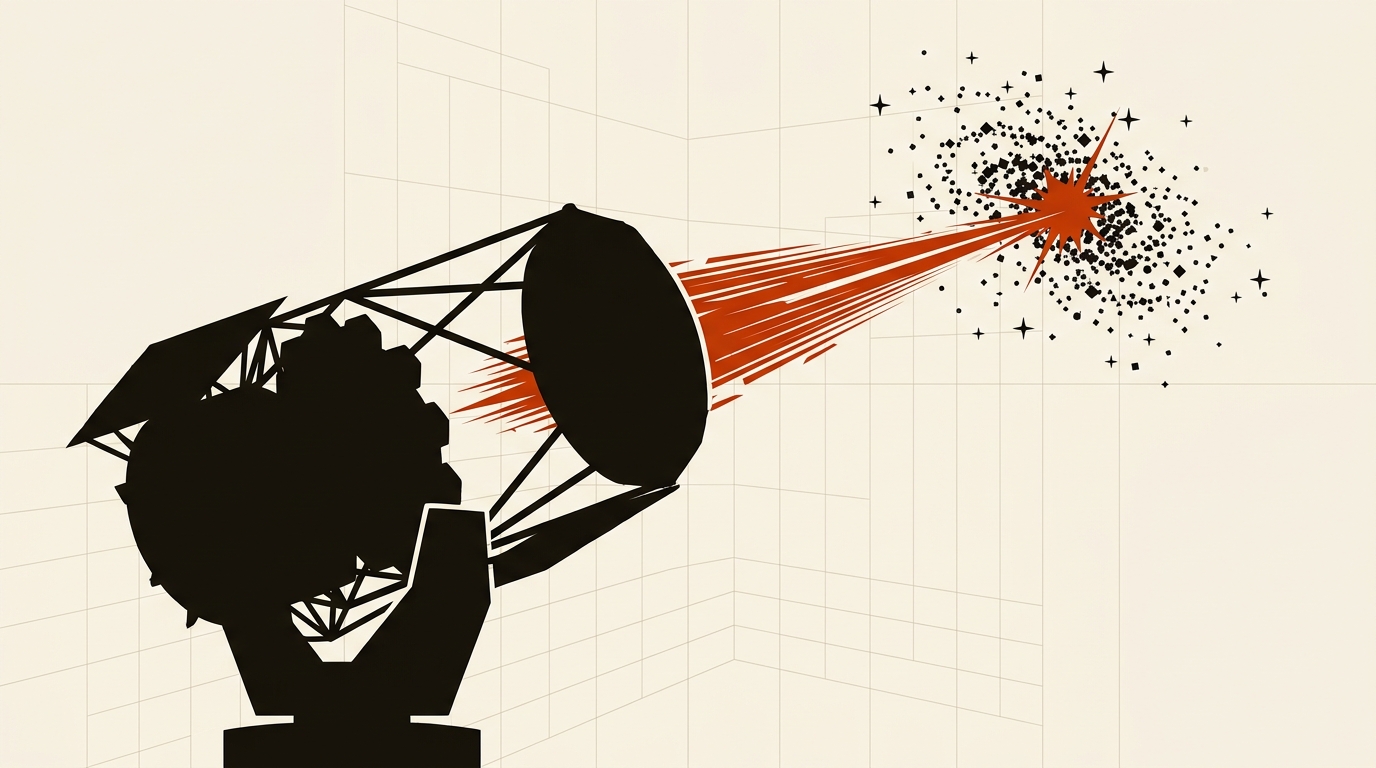
Tracing this 11-billion-year-old radio wave acts like a "cosmic flashlight," allowing scientists to map invisible matter and find hidden galaxy clusters.
Short answer: Astronomers have traced an 11-billion-year-old Fast Radio Burst (FRB) back to an unexpectedly small, metal-poor dwarf galaxy. This monumental discovery heavily favors the “magnetar theory” over colliding neutron stars as the source of these mysterious, ultra-powerful flashes.
1. What the discovery shows
If you have ever wondered what is out there in the deep universe, astronomers just caught a cosmic messenger that has been traveling toward Earth for over 10 billion years. They detected the most distant, ancient flash of energy ever recorded.
This phenomenon is called a Fast Radio Burst (FRB). For those unfamiliar with astrophysics, an FRB is an intensely powerful flash of radio waves that lasts for mere milliseconds but unleashes as much energy as our Sun produces in months or even years. This specific burst, designated FRB 20240304B, was first picked up by the MeerKAT radio telescope in South Africa. Because the burst was so faint and strange, astronomers called in the James Webb Space Telescope (JWST) to investigate further.
Using JWST’s highly sensitive infrared cameras, they traced the burst back to its origin point. They discovered that this flash happened when the universe was only about 3 billion years old. That means this radio wave has been traveling through space for roughly 11 billion years, spanning eighty percent of all cosmic history (Space.com, 2026). This officially doubles the distance of the previous record holder.
2. What the data actually says
Here is where the scientific community got a massive shock. For a long time, the origins of FRBs have been a total mystery. Scientists assumed that an explosion this massive had to come from a huge, mature galaxy packed with old stars.
However, official reports from NASA reveal the exact opposite. The host galaxy of this record-breaking burst is a tiny, metal-poor “dwarf galaxy” that is a thousand times less massive than astronomers expected. Despite its small size, this galaxy was in a “starburst” phase, meaning it was rapidly churning out new stars.
This discovery is a massive clue to solving what actually creates these bursts. It effectively rules out one of the major leading theories: colliding neutron stars. It takes billions of years for two dead neutron stars to orbit and finally crash into each other, meaning that event usually happens in much older galaxies (see our breakdown of ranking scientific theories).
Instead, finding this burst in a young, highly active dwarf galaxy strongly supports the magnetar theory. A magnetar is a young, highly magnetic dead star created right after a massive supernova explosion. Because the host galaxy is young and actively making huge stars that quickly explode, it creates the perfect environment for a magnetar to produce an FRB (NASA, 2026).
3. What’s missing / the footnote
Perhaps the most fascinating part of this discovery is what the burst did on its way here. As the FRB traveled 11 billion light-years to reach our telescopes, it passed through a lot of space filled with a hidden “cosmic fog” of gas and dust.
These bursts act like a “cosmic flashlight.” By measuring how the radio wave slows down and distorts on its way to Earth, scientists can effectively weigh the universe and map out invisible matter (The Guardian, 2026). In fact, this specific FRB illuminated an entirely unknown, hidden galaxy cluster located about 3.5 billion light-years away from us, proving that these bursts are invaluable tools for mapping the hidden architecture of the cosmos. Read more about similar massive science data checks in our Siberia lab fact check.
Sources to check yourself
- NASA — To read the primary data from the James Webb Space Telescope regarding the dwarf galaxy and the magnetar theory.
- Space.com — To explore further context on how this FRB doubles the previous distance record.
Frequently asked questions
Q: Could Fast Radio Bursts be alien signals? A: While popular on the internet, scientists have found zero evidence of artificial origins. The data strongly points to natural phenomena like magnetars.
Q: How do astronomers measure the distance of an FRB? A: They measure the “redshift” of the host galaxy, which indicates how much the light has stretched as the universe expanded during its journey to Earth.
Reader discussion
Conversation for this story opens with memberships. Until then: found an error? Report it — we correct visibly.